

Introduction
Wealth is not built by luck, motivation, or random hustle.
It is built through strong management skills.
Most people fail to build wealth not because they lack ideas, but because they cannot manage time, money, decisions, and systems properly.
This article explains practical management skills that directly help in wealth building, online income, and long-term financial growth.
No theory. No corporate nonsense. Only real-world skills that actually work.
there are some skills needed to grow online income
1. Time Management: The Foundation of Wealth
Time is the only asset you cannot recover.
Wealth builders treat time like money. They plan it, track it, and protect it.
Why it matters:
Poor time management = slow growth
Busy work ≠ productive work
High earners focus on high-value tasks
Wealth-focused approach:
Spend time on activities that increase income
Reduce tasks that don’t move money forward
Use schedules, not motivation
People who master time management grow faster than talented people who don’t.
2. Money Management Skills (Non-Negotiable)
You cannot build wealth if you don’t manage money properly.
Many people earn money but stay poor because:
No budgeting
No reinvestment plan
No financial tracking
Core money management skills:
Tracking income and expenses
Separating personal and business money
Reinvesting profits instead of wasting them
For wealth builders:
Every rupee/dollar must have a purpose
Small leaks destroy big income over time
Wealth is not about earning more. It’s about keeping and growing what you earn.
3. Decision-Making Skills That Increase Income
Bad decisions cost more than lack of skills.
Wealth builders make decisions based on:
Data
Long-term impact
Risk vs reward
Not emotions.
Strong decision makers:
Avoid shortcuts
Say no to distractions
Focus on scalable opportunities
Example:
Choosing one strong income source and scaling it
is better than chasing five random ideas.
- Clear decisions = faster growth + less stress.
4. Goal Management (Not Just Goal Setting)
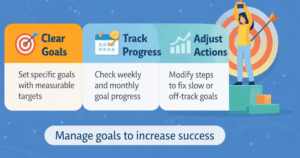
Most people set goals.
Few people manage them.
Wealth builders break goals into:
Daily actions
Weekly progress
Monthly results
Why this works:
Goals become measurable
Progress becomes visible
Motivation becomes natural
Practical tip:
Instead of saying: “I want to be rich”
Say:
“I want to increase my monthly income by 20% in 3 months”
- Managed goals turn dreams into systems.
5. Energy Management (Highly Ignored Skill)
Wealth building is a long game.
Burnout destroys more careers than failure.
Energy management means:
Knowing when to work hard
Knowing when to rest
Protecting mental focus
Wealth builders:
Don’t work 24/7
Work smart + consistently
Avoid emotional exhaustion
A tired mind makes poor financial decisions.
6. Skill Prioritization Management
Trying to learn everything is a mistake.
Wealth builders focus on income-producing skills first.
High-value skills include:
Digital marketing
SEO & content strategy
Sales & communication
Financial planning
Rule:
If a skill does not help you:
earn
save
or scale
It is not a priority.
Focus beats talent every time.
7. Risk Management for Long-Term Wealth
Wealth builders don’t avoid risk.
They manage it.
Smart risk management:
Never invest money you can’t afford to lose
Test before scaling
Diversify income sources gradually
Poor risk management leads to:
Panic decisions
Loss of capital
Quitting too early
Controlled risk builds wealth. Blind risk destroys it.
8. System Management (The Real Secret)
Wealth does not come from effort.
It comes from systems.
Systems work even when you are not active.
Examples:
Automated income streams
Content systems (blogs, videos)
Business workflows
Wealth builders ask:
“How can I make this repeatable?”
Systems create freedom. Hustle creates burnout.
9. Self-Discipline Management
Motivation is temporary.
Discipline is permanent.
Wealth builders manage:
Daily habits
Spending behavior
Focus levels
They don’t wait to “feel like it”.
Simple rule:
Do the work even when:
You are tired
You are bored
Results are slow
Discipline compounds faster than motivation.
10. Growth Management Mindset
Wealth building never stops.
Markets change. Skills expire.
Only learners survive.
Growth-focused people:
Improve continuously
Adapt quickly
Learn from failure
They don’t say: “I know enough”
They ask:
“What can improve my income next?”
Learning and self management skills are lifelong wealth skills.
Real Example (Practical & Believable)
Two people earn the same monthly income from online work.
Person A
Tracks income and expenses
Plans weekly work tasks
Reinvests part of earnings
After 1 year, Person A saves money, avoids losses and slowly increases income.
Person B
No budgeting
No time planning
Spends randomly
After 1 year, Person B earns the same but has no savings and constant financial stress.
Difference: management skills, not income.
Clear Comparison
| With Management Skills | Without Management Skills |
|---|---|
| Income is planned | Income is spent blindly |
| Time is used productively | Time is wasted on low value tasks |
| Growth is slow but stable | Income stays stuck or declines |
| Decisions are calculated | Decisions are emotional |
Final Thoughts (Clear & Honest)
Management skills are not optional for wealth building.
They are mandatory.
Without management:
Income disappears
Effort gets wasted
Growth stays slow
If you master:
time management for wealth building creator
money
decisions
systems
Wealth becomes predictable, not lucky.
Frequently Asked Questions
What is Management?
Management refers to managing resources (such as time, money and decisions) effectively through planning in order to accomplish goals.
How Income Management Skills help in build wealth?
Management Skills also build wealth through minimizing errors, increasing focus, and creating opportunities to accumulate long-term financial successes from income.
Can you learned Management Skills?
Management Skills Can be learned. Developing management skills is done daily through consistent habits; planned, systematic learning, and real-life situations.
Why people fail financially?
Many people experience financial failures as they focus on drawing in revenues but fail to utilize adequate time and effort to properly manage their time, expenses, and decision-making processes.
Checked out x777live. The live casino games are pretty cool, and the dealers are alright. Makes it feel more real. Worth a look if you like that kind of thing anyway. x777live