

richest 1% wealth — how much wealth does the top 1% own? — global wealth inequality — global income inequality data — wealth gap worldwide — richest 1% vs 99%
Executive summary
The richest 1% of adults hold a far larger share of global wealth than most people imagine. Estimates from major wealth datasets put the top 1%’s share somewhere around roughly 40–48% of total global personal wealth, depending on definitions and year. At the same time, the top 10% commonly control around three-quarters of global wealth, while the bottom half of adults hold only a few percent. These patterns reflect decades-long wealth concentration facts and continuing economic inequality trends that vary by country but add up to striking global imbalance. (Key sources: UBS Global Wealth Report, World Inequality Database / World Inequality Report, Oxfam analysis). (Inequality.org)
Introduction: Why measure the richest 1%?
Understanding wealth distribution 1% is crucial because wealth shapes political power, access to opportunity, the ability to ride out shocks (like pandemics or recessions), and long-term intergenerational outcomes. When policy debates invoke the “richest 1%” or the “99%,” they rely on measurable quantities — not metaphors — and those quantities can be estimated from household balance sheets, tax records, and capitalized income streams. But measurement choices matter: does “wealth” include property, businesses, pensions, and debts? Does it count only adults or households? Different data providers (banks, academic projects, NGOs) use different methods, which is why reported shares for the top 1% wealth can diverge.
How researchers measure the top 1%: definitions and pitfalls
Three common data sources are important:
- Household surveys + wealth registers (bank/industry reports): Banks like UBS and Credit Suisse estimate personal wealth by combining survey data, national accounts, and rich lists. These reports are timely and comprehensive about assets such as housing, financial assets, and debts — but they may undercount hidden offshore wealth or extremely concentrated fortunes. (Japan)
- Tax records and national accounts (academic databases): Projects like the World Inequality Database (WID.world) and the World Inequality Report use tax data and estate registers to reconstruct long-run trends. They are rigorous about top shares but sometimes have longer lags or limited coverage in low-income countries. (wid.world)
- Advocacy analyses (e.g., Oxfam): NGOs often reprocess bank or tax data to craft clear messages (for example, comparing the wealth of the top 1% to the bottom 95%). Their calculations highlight social and political implications but sometimes simplify methodological caveats to make communications sharper. (Oxfam International)
Common pitfalls: hidden assets (tax havens), non-adult units (children or households), fluctuating asset prices (equity booms inflate fortunes), and differing years. That is why a careful analysis blends sources and emphasizes ranges rather than single-ballpark figures.
The headline numbers: how much wealth does the top 1% own?
Recent syntheses converge on these broad facts:
- Top 1% global share: Multiple credible estimates place the global top 1% share of personal wealth at around 40%–48% in the early-to-mid 2020s. For example, bank analyses and inequality fact sheets cite figures close to the upper 40s for recent years. (Inequality.org)
- Top 10% share: The richest 10% of adults typically own roughly three-quarters (≈70–75%) of global wealth, meaning the remaining 90% share the rest across large populations. Recent reporting from inequality researchers echoes this proportion. (Al Jazeera)
- Bottom 50%: The poorest half of adults typically own only about 1–3% of global wealth (this varies by method), a striking demonstration of how concentrated assets are at the top. (wid.world)
- Ultra-concentration at the very top: Newer analyses emphasize that the top 0.1% and even the top 0.001% have been accumulating at especially fast rates, with the top 0.001% (tens of thousands of individuals) sometimes owning more than the combined wealth of hundreds of millions. Recent World Inequality Lab reporting highlights this accelerating ultra-concentration. (The Guardian)
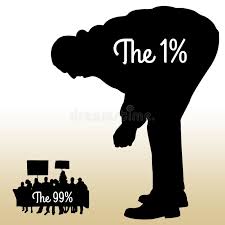
These headline numbers are why phrases like “richest 1% vs 99%” resonate: the 1% control a share large enough to shape macroeconomic outcomes.
Regional and national variation: not all countries are the same
Global averages hide big country differences:
- High-income countries—notably the United States—tend to have very high top shares: the U.S. top 1% controls a far larger fraction of national wealth than the average country, reflecting strong historical concentration and policy choices. Other advanced economies (UK, France) show high but somewhat lower top shares depending on housing and pension structures. Academic sources and country reports document these patterns. (wid.world)
- Emerging markets show mixed outcomes: rising millionaires and billionaires coexist with large populations holding little net wealth. Rapid asset appreciation (real estate, stocks) can boost top shares quickly in booming economies.
- Low-income countries often have much of their population with negligible wealth, so the addition of a small wealthy class can push top shares high. But data limitations make precise measurement harder in some places.
The upshot: global wealth inequality is a patchwork of national and regional trajectories underpinned by global capital markets.
Trends over time: are the richest 1% getting richer?
Yes — though not uniformly year to year. Key trend facts:
- Long-run rise since the 1980s: The share of wealth held by the top 1% and the ultra-rich rose markedly from the 1980s through the 2010s, driven by financial market liberalization, tax policy changes, and returns to capital outpacing wage growth in many countries. WID analysis documents long-run increases in top shares. (wid.world)
- Post-2008 dynamics: The Great Recession temporarily depressed asset values; since then, asset prices (especially equities and property) recovered strongly, benefiting asset-holders disproportionately and restoring or increasing top shares in many places. Many bank and NGO analyses of the 2020s show a renewed surge in billionaire wealth and upper-tail concentration. (Oxfam International)
- Recent acceleration among the ultra-rich: Newer reports highlight that the very top (0.01%–0.001%) have seen faster growth in wealth than the rest of the top 1%—an important nuance: concentration is intensifying at the very top even when the top 1% as a whole grows more moderately. (The Guardian)
Wealth vs. income inequality: related but different
It’s important to separate income (flow of earnings) from wealth (stock of assets):
- Income inequality measures (top shares of income) are high, but wealth inequality is usually even higher because wealth accumulates and compounds across generations. A high-income earner may spend much of what they earn; a wealthy family can earn returns from capital that expand the asset base.
- Global datasets (WID, UBS, Credit Suisse) show wealth concentration consistently above income concentration. That magnifies the political and economic implications: wealth begets influence, security, and control over investment decisions. (wid.world)
Wealth concentration facts that matter for policy and society
A few concrete facts to keep front-of-mind:
- Scale of concentration: When the top 1% owns roughly 40–48% of wealth, that means a small slice of the world’s adults control an outsized portion of private capital. (Inequality.org)
- The top 10% vs. bottom 50%: The richest 10% owning ~75% of wealth creates structural barriers to mobility and can depress broad demand growth if the middle and lower classes lack assets. (Al Jazeera)
- Ultra-rich acceleration: The top 0.001% increasing their share faster than others widens gaps within the top itself, making policy responses that target only the “top 1%” potentially insufficient. (The Guardian)
- Inheritance and unearned wealth: Analyses (e.g., Oxfam, UBS) indicate a substantial portion of billionaire wealth reflects inheritance, monopoly power, or political connections—raising questions about equal opportunity. (Oxfam GB)
Causes: why has the wealth gap widened?
A combination of structural, political, and market forces:
- Returns to capital > returns to labor (Piketty-style dynamics): When financial and property returns grow faster than wages, owners of capital pull further ahead. Academic and WID research document these mechanical effects over decades. (wid.world)
- Tax and regulatory policy: Lower top marginal tax rates, reduced estate taxes, and tax avoidance opportunities have increased after-tax accumulation at the top in many countries.
- Financialization: Growth of asset markets (equities, private equity, tech startups) concentrates gains among those with access — founders, investors, and institutional managers.
- Globalization and technology: High-skill wage premiums and the outsized returns to scalable digital platforms have created superstars whose gains are concentrated in a tiny set of owners.
- Political capture and rent extraction: Lobbying, regulatory capture, and monopoly rents can translate political influence into durable economic advantages for the few.
Consequences: why the wealth gap worldwide matters
Concentrated wealth has many spillovers:
- Political power: Wealth buys influence over policy, appointments, and media, skewing governance in ways that can perpetuate inequality.
- Economic fragility: When too much wealth concentrates, economies may suffer from underinvestment in broad consumption, increasing debt for households and instability in political economies.
- Social cohesion: Large gaps erode trust and can fuel populist and destabilizing politics.
- Climate and public goods: Concentrated wealth shapes investment priorities; some analyses point out that the ultra-rich’s emissions and capital allocation patterns matter for climate outcomes. (Le Monde.fr)
Policy responses: what can be done?
Policymakers and researchers propose a menu of tools — some politically realistic in certain countries, some ambitious globally:
- Progressive taxation: Higher marginal income taxes, stronger wealth taxes, and more effective estate/inheritance taxes can slow concentration. Proposals range from modest adjustments to more structural reforms.
- Wealth transparency and anti-avoidance: Closing offshore secrecy, strengthening beneficial-ownership registries, and curbing tax havens would reduce unseen accumulation.
- Investments in public goods: Universal education, healthcare, and childcare can level the playing field and improve mobility.
- Labor and market policies: Stronger unions, minimum wages, and antitrust enforcement can rebalance returns toward labor and reduce monopoly rents.
- Global coordination: Because capital is mobile, international coordination (minimum tax floors, information sharing) reduces harmful tax competition and helps enforce redistributive policies.
Scholars also debate trade-offs — e.g., the effect of wealth taxation on entrepreneurship — but the empirical case for some combination of progressive taxation, transparency, and public investment is strong in many analyses. (wid.world)
Case studies: recent findings that illustrate the picture
- UBS/Bank reports: Industry reports show the expansion of millionaires and the concentration of financial assets in wealthy households; they provide up-to-date snapshots of the distribution of personal wealth. These reports often underpin high-profile NGO messaging and policymaker briefings. (Japan)
- Oxfam’s headline comparisons: Oxfam’s analyses, using bank datasets, headline that the richest 1% own more than the bottom 95% and emphasize inheritance and corporate concentration as drivers. These claims are attention-getting and spark policy debates. (Oxfam International)
- World Inequality Lab: The World Inequality Report and WID.world provide long-run measures showing the growth of top shares and the rapid gains of the ultra-rich (down to the top 0.001%), underscoring structural shifts since the 1980s. Their research supports policy proposals like global minimum taxes and wealth levies. (wid.world)
Richest 1% statistics — a quick reference
- Top 1% global wealth share: ~40–48% (range depends on source and year). (Inequality.org)
- Top 10% global wealth share: ~70–75%. (Al Jazeera)
- Bottom 50% share: ~1–3%. (wid.world)
- Rapid recent growth among top 0.001%: yes — their share increased noticeably in recent decades. (The Guardian)
(These numbers should be read as order-of-magnitude, not exact point estimates — annual reports and methods shift results by a few percentage points.)
How robust are these numbers? Uncertainty and interpretation
- Method uncertainty: Different definitions (who counts as an adult, whether to count pension wealth, treatment of private business capital) change the exact share estimates. That’s why we report ranges and emphasize trends.
- Data gaps: In low-income countries, household survey coverage and tax records are thinner — often requiring interpolation. That can understate or overstate top shares if the rich are hard to observe.
- Market volatility: Stock market booms or busts can swing wealth shares in the short term — the broader trend matters most for policy.
Despite these caveats, multiple independent datasets point to very high concentration at the top, and that qualitative conclusion is robust.
Takeaways: the richest 1% vs 99% in one snapshot
- The richest 1% control a share of global wealth that is disproportionately large and has grown over recent decades. That means wealth concentration is a core structural feature of today’s global economy. (Inequality.org)
- The wealth gap worldwide (top vs bottom) is wide and persistent: the top decile owns most private capital, while the bottom half owns almost none.
- Policy responses exist: taxation, transparency, public investment, and competition policy can blunt the drivers of concentration — but political will and international coordination are essential to make them effective. (Oxfam GB)
Further reading and key sources
- UBS Global Wealth Report (annual editions) — up-to-date bank estimates of wealth distribution. (Japan)
- World Inequality Database (WID.world) and the World Inequality Report — long-run academic data on income and wealth shares. (wid.world)
- Oxfam analyses on billionaire and top 1% wealth — advocacy pieces that reframe bank data into policy storytelling. (Oxfam International)
- Recent journalism synthesizing these reports (Al Jazeera, Le Monde, The Guardian) — accessible summaries of the latest findings. (Al Jazeera)
Conclusion
The question “How much wealth does the richest 1% own?” yields a sobering answer: a plurality of global personal wealth — roughly forty to forty-eight percent — sits in the hands of the top 1%, depending on the measurement. That reality, combined with the even larger share of the top 10% and the tiny share held by the bottom half, creates deep structural imbalances with political, economic, and social consequences. Addressing those imbalances requires evidence-based policy, international cooperation, and public debate grounded in the data summarized above.
I was checking out nilfortuneonline and I like what I’m seeing. I’ll probably be back on tomorrow. nilfortuneonline